Related
Technopark Maroc at Emerging Valley 2024
Yassine Ait Oufkir with the Technopark Maroc (MITC) delegation at Emerging Valley 2024 in Marseille, alongside Lamiae Benmakhlouf, Directeur...
Popular topics
05 min reading in—Custom Apparel3D ConfigurationConferences
Your customer approved a flat mockup. Your production team received something they have to rebuild by hand. That gap is where the margin goes.
Here is a workflow I have watched in some version at nearly every custom apparel business I have visited.
A club wants twenty jerseys. Someone in sales mocks up a design — often in Illustrator, sometimes in a web tool, occasionally in PowerPoint. It goes to the customer as a flat image. The customer says the blue is wrong. Round two. The customer says the sponsor logo should be higher. Round three. Eventually: approved.
Then the approved file goes to production, and somebody spends the next hour rebuilding it.
Not adjusting it. Rebuilding it. Correct colour profile, correct separations, correct placement on the actual pattern pieces, correct sizing per garment size, names and numbers laid out from a roster that arrived as a spreadsheet with inconsistent capitalisation.
That hour is the real cost of a custom order, and almost nobody prices it in.
The mockup exists to close the sale. It is optimised for looking convincing on a screen. It does not need to know that the garment is cut from six pattern pieces, that the sublimation transfer needs bleed past the seam allowance, or that the customer's RGB blue does not exist in the ink set you are running.
The print file exists to drive a machine. It has to know all of those things.
They are made by different people, in different software, for different purposes. So the handoff between them is manual by construction — and manual handoffs are where errors enter.
The errors are not evenly distributed either. Most of them are invisible until the press runs:
You find these on press, on the garment, after you have consumed material and machine time. Then you eat the reprint, or you ship it and eat the complaint.
Hire better prepress people. This works, and it is expensive, and it does not scale. Your throughput is now capped by how many skilled operators you can hire in your city. It also means your best technical people spend their day on repetitive rebuilds instead of the genuinely hard jobs.
Lock down the templates. Restrict customers to a few fixed layouts. This reduces errors and it reduces orders, because the reason people buy custom is that they want something specific. You have solved a production problem by making the product worse.
Add approval steps. More sign-offs catch more errors, and every sign-off adds a day. In teamwear, where the order has to arrive before the season starts, added days lose deals outright.
Each of these treats the symptom. The disease is that the file the customer approved is not the file that goes to production.
The alternative is to make the customer's design be the production file — same object, two views.
That means the customer designs on the real garment: actual pattern geometry, actual print areas, actual constraints. Colours are constrained to what you can genuinely produce, so an approved colour is a producible colour. Logo placement is validated against seams and safe zones as the customer moves it. Minimum resolution is enforced at upload, not discovered at output. Rosters are structured data, not a pasted spreadsheet.
Then the order produces the print-ready output automatically — separations, bleed, per-size scaling, correct profile for DTG, sublimation, screen print or embroidery.
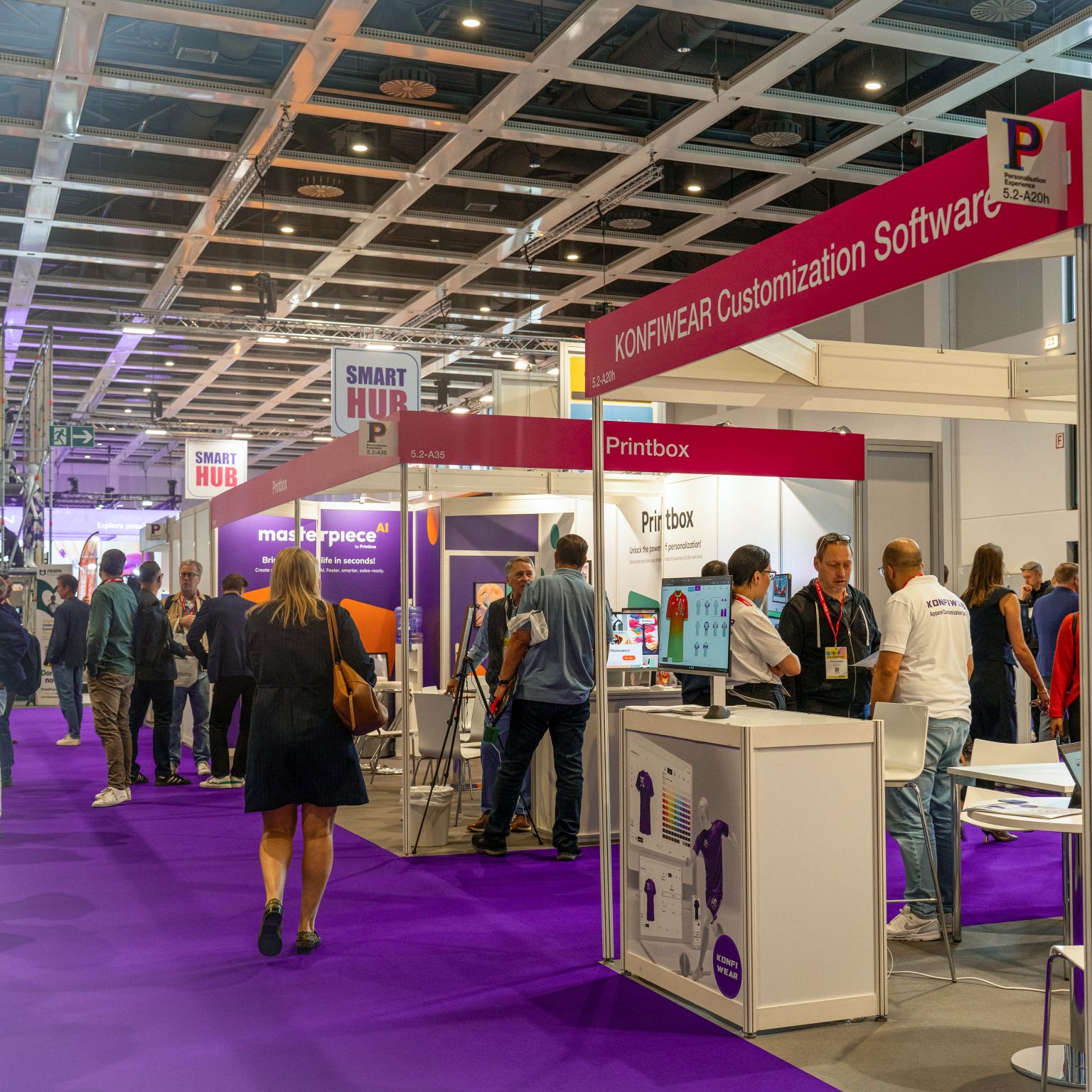
This is what we built Konfiwear to do, so I am obviously not a neutral party. But the principle stands regardless of whose software you use: if a customer can approve something you cannot produce, your workflow has a manual repair step in it, and you are paying for that step on every single order.
The hour of rebuild goes away. That is the obvious one, and it is not the important one.
The important one is what happens to the front of the process. When the customer is looking at their actual garment rather than an approximation, the approval rounds collapse — usually to one. The uncertainty that caused round two and round three was never really about the design. It was the customer not trusting that what they saw was what they would get.
Custom apparel buyers do not abandon orders because of price. They abandon because they are not sure, and the cost of a wrong order of 200 jerseys is high enough that not-sure means not-yet.
Remove the doubt at the point of design, and you get the production saving as a side effect.
Not "how do we make prepress faster?" but:
How many hours a week does this business spend converting files a customer already approved into files a machine can actually run — and what would we do with those hours instead?
Most operations I ask have never counted it. The number is usually larger than they expect.
Related
Yassine Ait Oufkir with the Technopark Maroc (MITC) delegation at Emerging Valley 2024 in Marseille, alongside Lamiae Benmakhlouf, Directeur...
Related
Yassine Ait Oufkir speaking at Technopark Tangier as a Rising UP in Spain ambassador — how Asturias and ICEX helped scale Konfigear, with Martín...
Related
Yassine Ait Oufkir at South Summit 2024 in Madrid — pitching Konfigear on the Start in Asturias stage, and three days on the Asturias Startup...